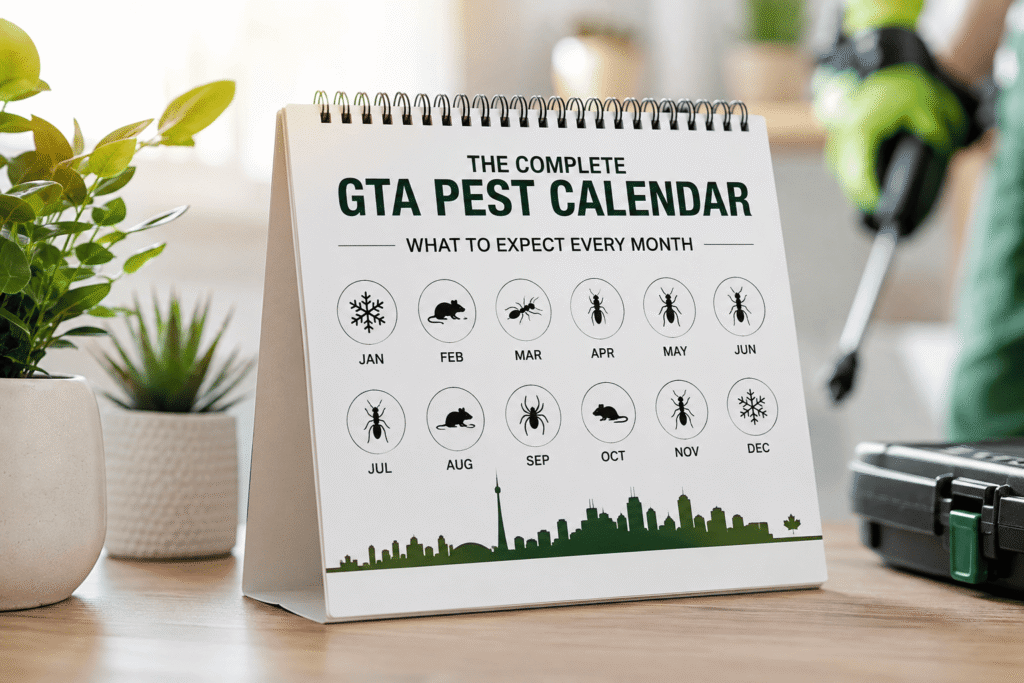
Pest problems often begin long before you notice them. They start weeks earlier, on a schedule. The GTA pest calendar follows a predictable pattern year after year, and knowing it means you can act before a problem shows up, not after.
This guide pulls together seasonal pest control Ontario data from every pest category, sourced from Public Health Ontario and Toronto Public Health, into one month-by-month reference. No other resource in this market puts it all in one place.
Why Pest Timing Actually Matters
Every pest in the GTA follows a biological clock. Ants become active as soil warms. Ticks emerge in two distinct waves tied to their life cycle. Wildlife dens earlier or later depending on the season.
Treating on a schedule that matches this timing works better than reacting after an infestation is visible. It’s also cheaper: a spring exclusion job costs less than a fall emergency call.
Spring (March to May): The Wake-Up Season
What’s Active in Spring
Ant season begins in March and builds through May, as colonies that overwintered underground start foraging again. Carpenter ants and wasp queens emerge around the same window, searching for new nesting sites.
Raccoons begin their earliest denning season in March, often in attics and chimneys. This overlaps with the start of wildlife baby season, which continues into the summer.
The One Thing to Do in Spring
Seal obvious entry points now, before ants and wildlife find them first. A gap sealed in March is a gap that never becomes a June infestation.
See our ant control page for signs your colony has already moved in: gtapestsolutions.ca/ant-control/
Mini summary: Spring is when ants, carpenter ants, and denning wildlife all activate at once. Entry-point sealing done now prevents most of what shows up later.
Early Summer (May to June): The Most Dangerous Tick Window
What’s Active in Early Summer
This is the single most important window on the entire calendar for one specific pest. Blacklegged tick nymphs, the immature stage responsible for most Lyme disease transmission, emerge and peak during May and June.
Nymphs are roughly the size of a poppy seed. They’re active in tall grass, leaf litter, and wooded yard edges exactly when GTA families are spending the most time outdoors.
Why Nymph Season Matters More Than People Think
Public Health Ontario reports that approximately 70% of all confirmed Lyme disease cases in the province are reported in June, July, and August, a window that lines up directly with nymph activity and increased outdoor time. Nymphs are hard to spot precisely because of their size, not because they’re rare.
See our tick control page for the full nymph identification guide and yard treatment timing: gtapestsolutions.ca/tick-control/
Mini summary: May and June are the highest-risk months for tick exposure in Ontario, driven by nymphs too small to easily see. This is the window a yard treatment matters most.
Peak Summer (July to August): Wasps, West Nile, and Wildlife Babies
What’s Active in Peak Summer
Wasp colonies, which started small in spring, reach their largest size in late summer, sometimes housing thousands of workers. This is also when most wasp calls come in, since nests are now large enough to notice.
Squirrels typically have a second litter in late summer, adding another wave to attic activity that started with raccoons in spring.
The West Nile Virus Window
Toronto Public Health confirmed the city’s first 2026 West Nile virus case on July 30, consistent with the typical seasonal pattern. Public Health Ontario identifies August and September as the peak months for reported West Nile virus cases province-wide, driven by Culex mosquito activity in standing water.
Ontario recorded 181 confirmed cases in 2025, the highest total on record for the province.
See our mosquito control page for standing-water prevention and seasonal treatment: gtapestsolutions.ca/mosquito-control/
See our wasp nest removal page if a nest has already grown large enough to notice: gtapestsolutions.ca/wasp-nest-removal/
Mini summary: Peak summer combines the largest wasp nests of the year with the highest West Nile virus risk window. Both problems are easier to handle before August than during it.
Fall (September to November): The Entry Season
What’s Active in Fall
As temperatures drop, mice and rats begin actively searching for a way indoors, with entry attempts peaking in late October and November. This is the single busiest season for rodent calls all year.
Spiders push indoors as outdoor prey becomes scarce and temperatures cool, making fall the second-biggest spider season after their usual summer presence. Ticks have a second, smaller activity peak in September and October as adults become active again.
Why Fall Is the Most Important Season to Act
A gap that let ants in during spring is the same gap a mouse will find in October, just with higher stakes. Rodents contaminate food and chew wiring, and fall is when they’re actively looking for exactly the entry points spring pests already found.
See our rodent control page for the entry-point checklist before peak season hits: gtapestsolutions.ca/rodent-control/
Mini summary: Fall is the busiest rodent season of the year, plus a second tick peak and a fall spider push. Entry-point sealing is the highest-leverage action in this window.
Winter (December to February): Indoor-Only Season
What’s Active in Winter
Outdoor pest activity mostly stops, but whatever got inside during fall is now established. Mice and rats that entered in October are now indoor residents, not new arrivals.
Cockroaches and bed bugs are active year-round indoors, but winter brings a specific bed bug risk: increased holiday travel means increased opportunity to bring them home.
See our bed bug removal page for hotel and travel prevention checks: gtapestsolutions.ca/bed-bug-removal/
Mini summary: Winter pest activity is entirely indoor. What you’re dealing with in January is usually what got in during fall, not a new problem.
The Full GTA Pest Calendar at a Glance
| Season | Primary Activity | Key Action Window |
|---|---|---|
| Spring (Mar–May) | Ants, carpenter ants, raccoon denning begins | Seal entry points early |
| Early Summer (May–Jun) | Tick nymph peak, highest Lyme risk | Yard treatment before outdoor season |
| Peak Summer (Jul–Aug) | Wasp nests peak, West Nile virus peak | Mosquito prevention, wasp nest checks |
| Fall (Sep–Nov) | Mouse/rat entry surge, second tick peak, spiders indoors | Entry-point sealing before winter |
| Winter (Dec–Feb) | Indoor-only: established rodents, travel-related bed bugs | Monitor existing entry points |
Key Takeaways
- Pest activity in the GTA follows a predictable, repeatable seasonal pattern, not random timing.
- May and June carry the highest Lyme disease risk, per Public Health Ontario, driven by hard-to-see tick nymphs.
- August and September are the province’s peak West Nile virus months, confirmed by Toronto Public Health’s 2026 case data.
- Fall is the single busiest season for rodent entry, as mice and rats search out gaps before winter.
- Acting a season ahead (sealing entry points in spring, treating yards before nymph season) costs less than reacting to an established problem.
Frequently Asked Questions
What month should I start pest prevention in the GTA?
March is the earliest practical starting point, since ants and early wildlife activity begin then. Sealing entry points in spring prevents most of what would otherwise show up in summer and fall.
Why is May considered the most dangerous month for ticks?
Tick nymphs, the life stage responsible for most Lyme disease transmission, emerge and peak in May and June. Their small size (about a poppy seed) makes them far harder to spot than adult ticks.
Is West Nile virus a real risk in Toronto?
Yes. Toronto Public Health confirmed its first 2026 case on July 30, and Ontario recorded 181 cases in 2025, the highest on record. Peak risk months are August and September.
Why do I get more mice in the fall than any other season?
Cooling temperatures drive mice and rats to actively search for indoor shelter, with entry attempts peaking in late October and November. It’s the single busiest rodent season of the year.
Do ticks disappear in the fall?
No. Adult blacklegged ticks have a second, smaller activity peak in September and October, after the larger spring nymph peak.
What pest is most active in winter in the GTA?
Outdoor activity mostly stops, but mice, rats, cockroaches, and bed bugs remain active indoors year-round. Winter risk is largely about what already got inside during fall.
Does this calendar apply to the whole GTA, or just Toronto?
The seasonal patterns (tick nymph timing, mosquito season, fall rodent entry) apply across the whole Greater Toronto Area, since they’re driven by regional climate, not city boundaries.
Should I treat my property before I see a pest, or wait until I do?
Treating ahead of the seasonal window, yard treatment before nymph season, entry sealing before fall, costs less and works better than waiting for a visible infestation.
Conclusion
The GTA’s pest calendar repeats every year with the same rhythm: ants and wildlife in spring, ticks peaking in early summer, wasps and West Nile risk through August, and a rodent surge every fall. Knowing which window you’re in tells you what to actually watch for, instead of reacting to whatever shows up first.
If you’d rather have a property-specific plan than track every season yourself, that’s what a seasonal inspection is for.
Ready for the season ahead? Book a free inspection and we’ll tell you exactly what to expect on your property this season, and what to do about it before it becomes a problem.