Ethical bee removal and honey bee relocation for homes and businesses across Toronto and the GTA.
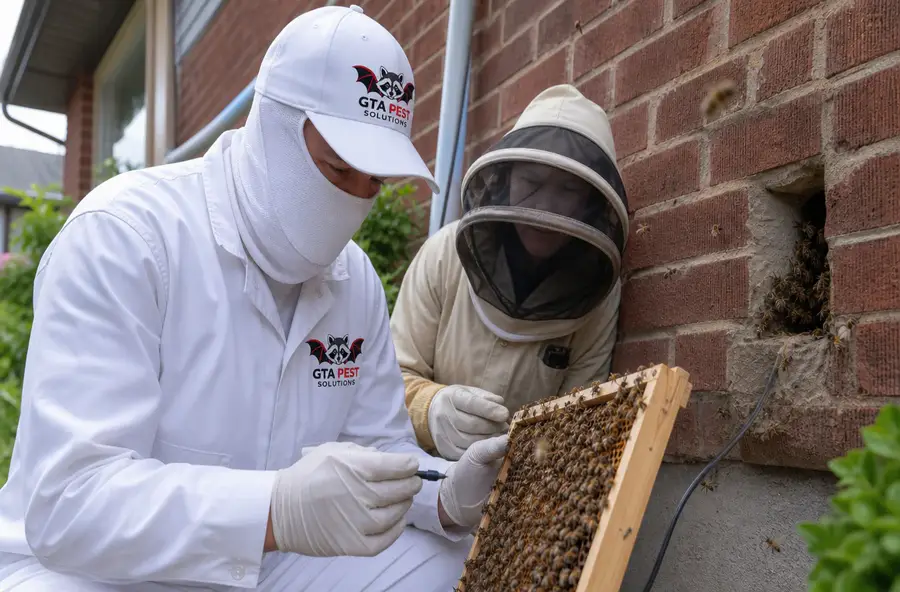
Bee removal in Toronto starts with identifying the species and determining whether the bees are part of an established colony, a temporary swarm, or another type of nesting activity. Honey bees, carpenter bees and bumblebees behave differently and require different approaches.
GTA Pest Solutions provides bee removal services for residential and commercial properties across Toronto and the GTA. Our technicians assess the location, activity and accessibility before recommending relocation, treatment or other appropriate action.
When a confirmed honey bee colony can be safely relocated, we coordinate with a beekeeper rather than treating it as a conventional pest infestation.
Found a hive or hearing buzzing in a wall?
The first step in bee removal is identifying which type of bee is present because the appropriate response depends on the species, nesting location and level of activity.
| Comparison | Honey Bee | Carpenter Bee | Bumblebee |
|---|---|---|---|
| Scientific Name | Apis mellifera | Xylocopa virginica | Bombus species |
| Lives | Large colonies containing thousands of bees. | Solitary; drills nesting tunnels into bare wood. | Small colonies, often nesting underground. |
| Look | Fuzzy, golden-brown body with dark stripes. | Shiny black abdomen that resembles a bumblebee. | Round, very fuzzy body with black and yellow markings. |
| Our Approach | Live relocation in partnership with a local beekeeper whenever possible. | Void treatment followed by sealing exposed wood to discourage re-nesting. | Relocation or left undisturbed where it poses no safety risk. |
Not sure which one you’re dealing with?
Before arranging bee removal, check whether you are seeing a temporary swarm, individual bees visiting flowers, or repeated activity at a specific nesting point. These signs can help indicate whether an established colony is present.
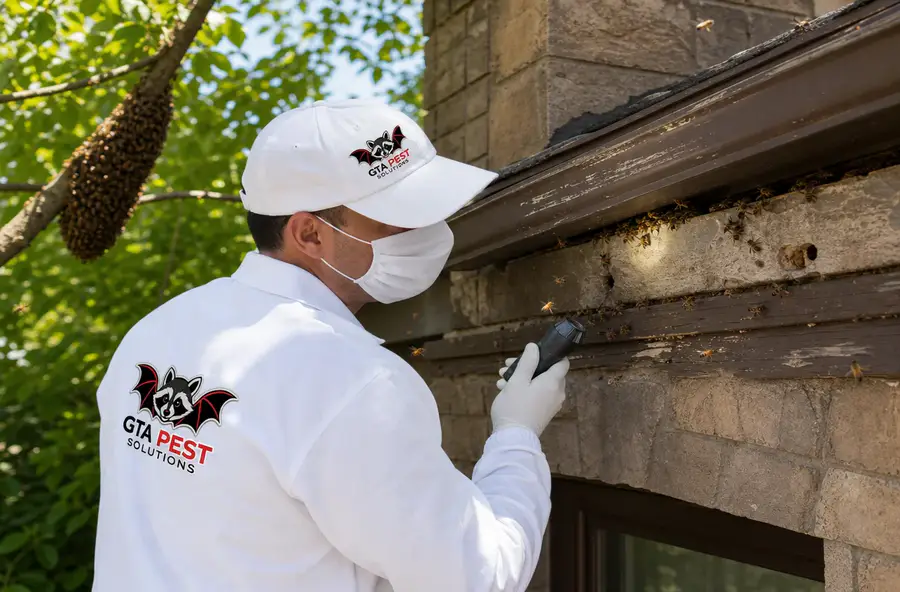
Buzzing sound behind drywall?
Yes, and it’s worth taking seriously. Honey bees are far less defensive than wasps day to day. But an established colony will sting to protect itself if a wall is opened or a hive is disturbed without care.
For anyone with a known bee sting allergy, even a single sting can escalate to a severe reaction requiring emergency care.
For this reason, established colonies should be assessed and handled by trained professionals using appropriate protective equipment.
A resting swarm is a different story. With no hive yet to defend, swarming bees are typically calm. This is part of why they can often be left alone for a day or two before collection.
Anyone nearby with a bee sting allergy?
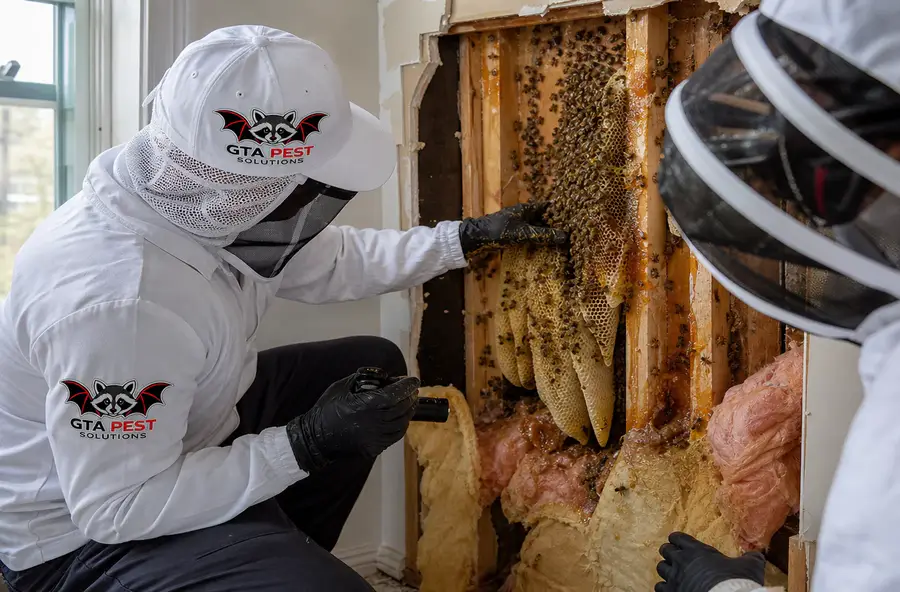
An established honey bee colony inside a wall should not simply be sealed in place. As honey and comb accumulate, they can create moisture, odour and structural-cleanup issues if the colony later dies or leaves.
Once that happens, relocation alone isn’t enough. The honeycomb and residue need to be fully removed, or the smell and residue will attract a new swarm to the same spot next season.
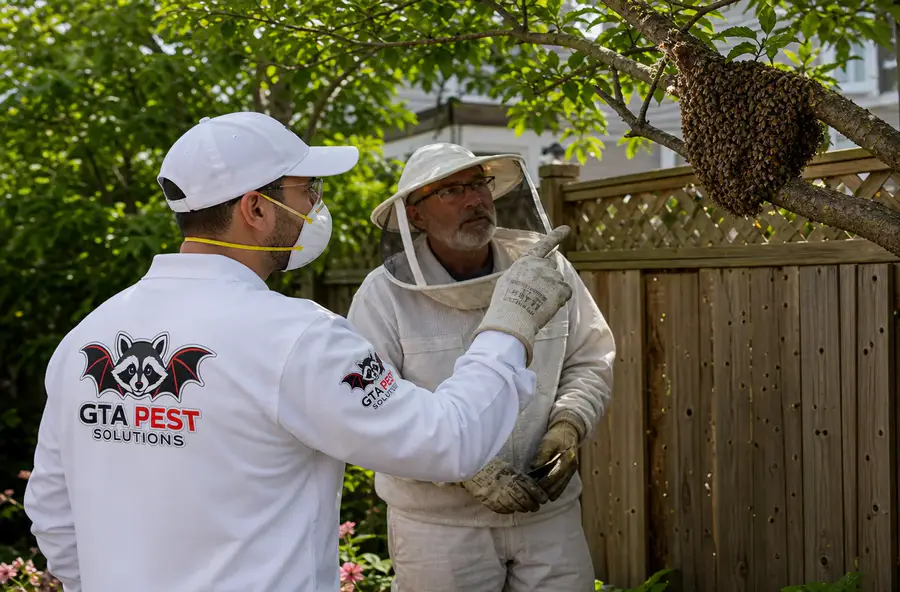
Honey bee swarms peak in late spring, when an established colony outgrows its space and splits. Half the bees leave with a new queen to find a home. Carpenter bee activity typically starts a few weeks earlier, as overwintered females emerge to nest.
A swarm in a tree or on a fence is usually temporary and surprisingly calm. Swarming bees have no hive to defend yet, which is why they’re far less likely to sting than an established colony.
Spotted a swarm that hasn’t settled yet?
Honey bee swarming in the GTA typically occurs in late spring as established colonies reproduce and part of the colony leaves with a queen to establish a new home. A temporary swarm may gather on a tree, fence or other structure while scout bees search for a suitable nesting location.
A swarm in a tree or on a fence is usually temporary and surprisingly calm. Swarming bees have no hive to defend yet, which is why they’re far less likely to sting than an established colony.
Spotted a swarm that hasn’t settled yet?
A typical bee removal service follows these steps, with the treatment approach adjusted according to the species and nesting location:
We determine honey bee, carpenter bee, or bumblebee before recommending anything.
A registered beekeeper is coordinated for live bee relocation, including comb and brood where the colony is inside a structure.
Active tunnels are treated, then sealed and finished to prevent reuse next season.
The original access point is closed once bees are cleared, to stop scout bees from resettling the same spot.
We confirm no residual activity before the job is marked complete.
Ready to get the species confirmed?
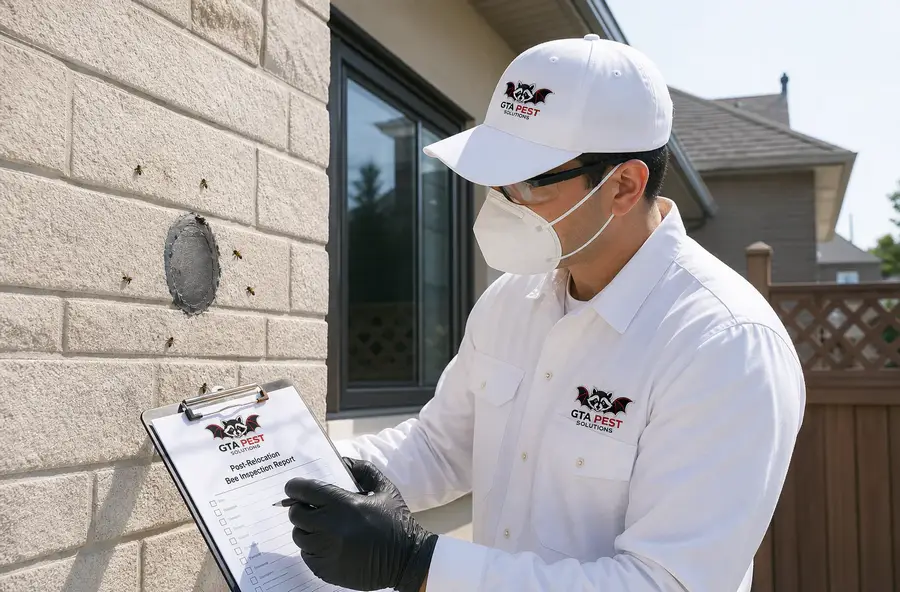
A small number of scout bees may return to the original location for several days after relocation while searching for the colony. This can be normal and does not necessarily mean the removal failed.
Once the entry point is properly sealed, this activity fades on its own within a week or so.
Still seeing a few bees after service?
The time required for bee removal depends mainly on whether the bees are a temporary swarm or an established colony and whether the colony is inside a structure. A visible swarm in an accessible location may be collected relatively quickly, while a colony inside a wall or chimney can require structural access, comb removal, cleanup and sealing.
A colony established inside a wall or chimney takes longer. The cavity has to be opened, the comb and brood removed intact for the beekeeper, and the space cleaned and sealed. This usually runs to a single extended visit rather than multiple return trips.
Want a time estimate for your specific situation?
GTA Pest Solutions has coordinated honey bee relocations and carpenter bee treatments across the GTA for 10+ years. Every visit is backed by our written service guarantee, detailed on the Guarantee page. Our credentials are listed under Licensing & Certifications , and past customer feedback is on the Reviews page.
EXCELLENT Based on 7 reviews
 Posted on Google
 khurram darajiVery satisfied result by GTA Pest Solutions for Rodents Extermination 100% Recommend for quick response and quality service with great knowledge Office staff also Very friendlyPosted on Google
 Atta Ul AwalAbsolute Lifesavers! Exceptional Service from Mark & GTA Pest Solutions. I highly recommend GTA Pest Solutions! If you are dealing with pest or wildlife issues around your home, this is the team to call. We were at our wit's end dealing with raccoons visiting our backyard almost every night and leaving behind a complete mess. Thankfully, we reached out to GTA Pest Solutions, and Mark came out to help us. From start to finish, his professionalism was top-tier. What truly sets Mark apart is his incredible knowledge and expertise. Rather than just offering a quick fix, he took the time to do a thorough survey of our property to uncover the root cause of the raccoon activity. He walked us through his findings, explained everything clearly, and gave us a permanent solution. As an amazing bonus, while doing his survey, Mark spotted subtle clues indicating an ant problem in another area of the yard. He pointed out the evidence to me and provided expert advice on how to properly treat it. It is rare to find a professional who is this thorough, attentive, and genuinely invested in helping a homeowner. Thank you, Mark at GTA Pest Solutions, for giving us back our clean, peaceful backyard! Outstanding service from a true expert.Posted on Google
 Shawn AbrahimThe exterminator did a great job. He was easy to coordinate with, provided fast effective service and was knowledgeable. Would certainly use this company again in the futurePosted on Google
 Michael VolineVery good service, the guy was able to come within 24 hours and he removed the wasp nest very quicklyPosted on Google
 Tahir AhmedThanks for the best service. Helped to eliminate cockroachs infestation.Posted on Google
 Faiza Bajwa100% Recommend for wasps and hornets
Join our satisfied GTA customers.
Not if they’re honey bees. Confirmed honey bee colonies are relocated with a registered beekeeper. Carpenter bees and, in some cases, aggressive ground-nesting bumblebee colonies near high-traffic areas are treated directly.
Cost depends on species, colony size, and whether a wall or structure needs to be opened. We quote a firm price after a free assessment, and the Pricing (/pricing/) page walks through how that’s calculated.
Usually not. A swarm resting in a tree or on a fence has no hive to defend yet, so it’s typically calm. Keep a reasonable distance and avoid provoking it while waiting for a technician.
Carpenter bee males have a shiny black abdomen and drill into bare wood alone. Bumblebees are rounder, fuzzier all over, and usually nest in the ground or in old rodent burrows in small colonies.
Yes. Bumblebee nest removal is available, though since bumblebees are also valuable pollinators, we relocate where the location allows it rather than defaulting to extermination.
Sometimes, if it’s temporary and not in a high-traffic area. If it’s still there after a couple of days, or has entered a wall or roof void, it’s worth having a technician confirm what’s actually happening.
Yes. We cover Mississauga, Brampton, Vaughan, Markham, and the rest of the GTA with the same relocation-first approach.
2985 Drew Rd # 213, Mississauga, ON L4T 0A7

Copyright © 2026 GTA Pest Solutions. All rights reserved.