
If it feels like you’re seeing more rats in Toronto than a few years ago, you’re not imagining it. City data, a peer-reviewed global study, and the province’s own transit agency all point to the same trend: rat activity across Toronto has been climbing for a decade, and 2026 is shaping up to be no exception.
This isn’t a marketing angle. Every figure below traces back to the City of Toronto’s own service-request data or a peer-reviewed study published in Science Advances, not a vague “population boom” claim.
This article breaks down exactly what’s driving rats in Toronto right now, what the city is actually doing about it, and what the data means for your own property.
The Numbers Behind the Headlines
What the City’s Own Data Shows
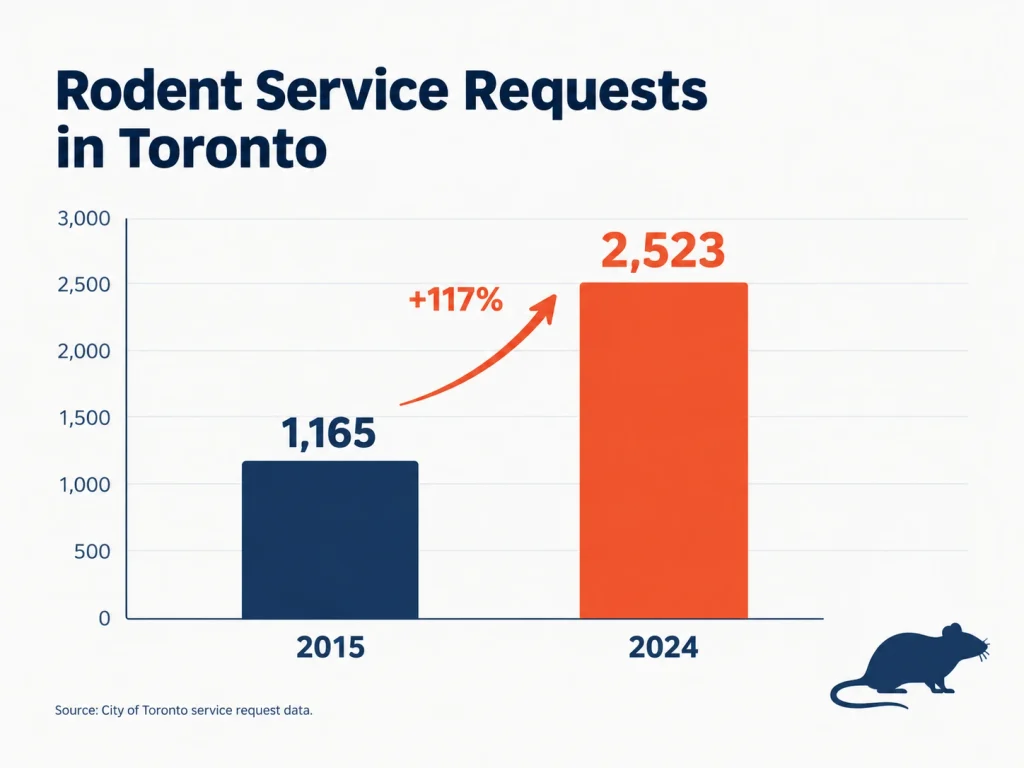
The City of Toronto’s own figures are the clearest starting point. Rodent-related service requests climbed from 1,165 in 2015 to 2,523 in 2024, roughly double in under a decade.
That’s not a single bad year skewing the average. The increase has been reported consistently across multiple sources, including CBC News and the city’s own committee reports, as part of the case for Toronto’s first coordinated rat strategy.
Whatever the exact cause on any given street, the citywide pattern behind rats in Toronto is consistent enough now that the city built an entire response plan around it.
Where Toronto Ranks Globally
A peer-reviewed study published in Science Advances in early 2025, led by Jonathan L. Richardson of the University of Richmond, analyzed long-term rat complaint and inspection data across 16 global cities.
Toronto ranked third for the steepest rise in rat numbers over the study period, behind only Washington, D.C. and San Francisco, and ahead of New York City.
See our rodent control page for how these trends show up on individual properties across the GTA.
Mini summary: Two independent sources, city data and a peer-reviewed global study, agree: Toronto’s rat numbers have been rising for years, not just this season.
Why Rats Are Increasing, Not Just Being Reported More
Construction Is Displacing Established Colonies
Toronto’s construction boom is a genuine driver, not a coincidence. Metrolinx, the agency building the Ontario Line, has introduced a formal Pest Management Strategy specifically because excavation and tunnelling through densely populated neighbourhoods disturbs existing rodent habitats.
Excavation doesn’t eliminate a colony. It scatters it into surrounding streets, yards, and nearby properties looking for a new place to establish.
This is one reason rats in Toronto tend to cluster near active project corridors rather than spreading evenly across the city.
Warmer Winters Are Extending the Breeding Season
The Science Advances study found that cities with the steepest warming trends over the past 50 years also had the fastest-growing rat numbers. Toronto was among the five cities showing the strongest link between the two.
Milder winters mean rats spend less time in survival mode and more time breeding, which compounds year over year rather than resetting each season.
Mini summary: Construction displacement and warmer winters are two separate, independently confirmed drivers, not one company’s theory.
What Toronto Is Doing About It
The Rat Response Plan
The city approved its first coordinated Rat Response Plan in 2025, rolling out through 2026. It includes a dedicated coordination team, public education campaigns, and pilot programs testing non-rodenticide controls like carbon monoxide burrow treatments and electric monitoring sensors.
The plan also requires rat-management planning for city-led construction sites, and advises private and Metrolinx-led projects to do the same.
What the City’s Plan Doesn’t Cover
This is the detail worth knowing before assuming the problem is being handled for you. The Rat Response Plan covers public property: parks, transit corridors, and city construction sites.
Rats on private property remain the owner’s responsibility. You can report activity on public land to 311, but a rat problem on your own home or business still requires a licensed pest control professional.
Mini summary: The city’s plan targets public infrastructure. Private homes and businesses are explicitly not covered, and that responsibility doesn’t change as the plan rolls out.
What This Means for Your Property
A citywide trend doesn’t predict what happens at any single address, but it does change the odds. If your property sits near active construction, an older sewer connection, or a ravine corridor, you’re in exactly the conditions this data describes.
The broader trend behind rats in Toronto doesn’t change what actually stops an infestation on your own property: finding and sealing the entry points before a displaced colony settles in.
See our Rodent Control page for the entry-point sizes and exclusion methods that stop rats before they establish, regardless of what’s driving activity in your neighbourhood.
Mini summary: Citywide data explains the trend. What stops a rat problem on your specific property is still entry-point prevention, done before pressure peaks.
Key Takeaways
- City of Toronto data shows rodent service requests roughly doubled from 2015 to 2024, a real trend confirmed by the city’s own committee reports.
- A peer-reviewed Science Advances study ranks Toronto third among 16 global cities for the steepest rise in rat numbers, behind only Washington, D.C. and San Francisco.
- Metrolinx has introduced a dedicated Pest Management Strategy for Ontario Line construction, confirming displacement is a recognized, actively managed issue.
- Warmer winters extend the rat breeding season, compounding population growth year over year.
- The city’s Rat Response Plan covers public property only. Rats on private property remain the owner’s responsibility.
Frequently Asked Questions
Are there really more rats in Toronto than a few years ago?
Yes. City of Toronto service-request data shows rodent complaints rose from 1,165 in 2015 to 2,523 in 2024, and a peer-reviewed Science Advances study independently ranked Toronto third among 16 global cities for the fastest-rising rat numbers.
Why is Toronto’s rat population increasing?
Two confirmed factors: construction displacement, as excavation for projects like the Ontario Line disturbs established colonies, and warmer winters, which extend the breeding season and let more rats survive year over year.
Is the increase just because more people are reporting rats?
No. The Science Advances study used long-term complaint and inspection data specifically to control for reporting changes, and still found a significant upward trend in Toronto’s actual rat numbers.
What is Toronto doing about the rat problem?
The city approved a Rat Response Plan in 2025, rolling out through 2026, with a coordination team, public education, and pilot non-rodenticide controls. It also now requires rat-management planning for city construction sites.
Does the city’s Rat Response Plan cover my house?
No. The plan covers public property (parks, transit corridors, city construction sites). Rats on private property remain the homeowner’s or business owner’s responsibility, though public-land activity can be reported to 311.
How does the Ontario Line construction affect nearby homes?
Metrolinx has introduced a formal Pest Management Strategy because excavation and tunnelling disturb existing rodent habitats along the route, which can displace colonies into nearby residential streets and properties.
Which Toronto neighbourhoods are most affected?
Areas near active construction, older housing stock with aging sewer connections, and properties close to ravines or parks tend to see the most rat pressure, since these conditions combine shelter, food access, and displacement routes.
What should I do if I’m seeing more rat activity near my property?
Don’t wait for city programs to reach your street. A property-level inspection to identify entry points is the most effective step, since municipal plans are designed for public infrastructure, not individual homes.
Conclusion
Rats in Toronto aren’t a perception issue or one company’s marketing narrative. City data, an independent peer-reviewed study, and the province’s own transit agency all confirm the same trend from different angles: construction displacement and warmer winters are pushing rat numbers up across the city, and the pattern has been building for a decade.
The city’s response plan is a genuine step forward for public property, but it doesn’t extend to private homes and businesses. That part is still on you.
Noticing more activity near your property? Book a free inspection and we’ll identify entry points before a displaced colony becomes an established one on your property.