
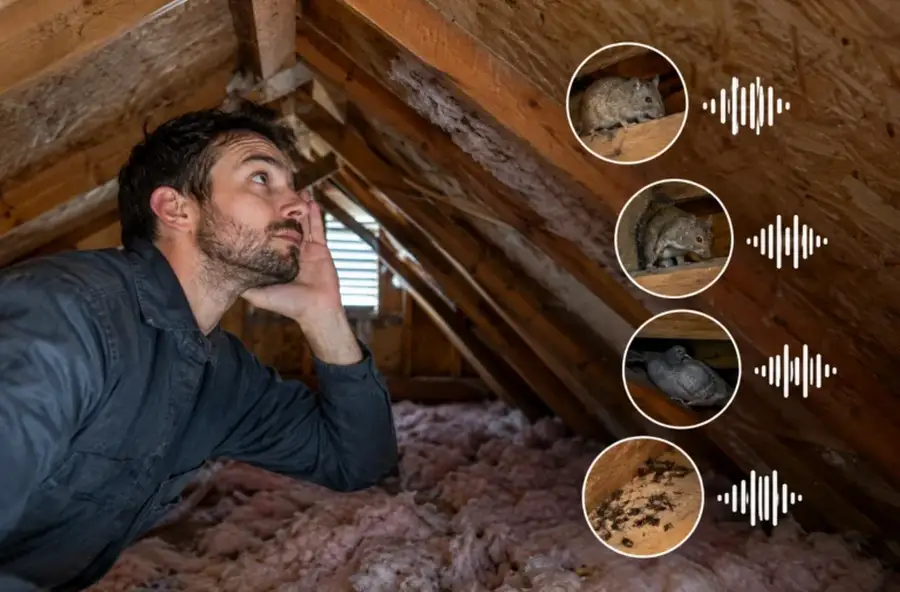
You hear it around 11pm. Heavy footsteps, right over your bedroom, moving like something with real weight behind it. That’s often exactly how a noise in attic Toronto case starts, and the pattern and timing of what you’re hearing will tell you more than almost anything else before you decide what to do.
This guide breaks the sound down by type, by time of night, and by what it means in practice, including what Ontario law actually allows you to do about it yourself.
How Common Is This in the GTA?
Attic noise complaints aren’t rare in this region. The Toronto Wildlife Centre fields approximately 30,000 calls a year covering more than 300 species, and raccoons are consistently among the most common. A peer-reviewed density study by Ontario Ministry of Natural Resources researchers, published in the Journal of Mammalogy, measured raccoon density in Metropolitan Toronto at 7 to 12 animals per square kilometre, among the highest urban densities recorded in the province.
If the sounds point toward a raccoon, our raccoon removal page covers the full process. For lighter, daytime activity that sounds more like a squirrel, see squirrel removal instead. Not sure which one you’re dealing with? Our wildlife removal team can identify the animal before anything gets trapped or sealed.
Where the Sound Is Coming From Matters First
When you notice noise in attic Toronto homes, the first step is to place exactly where the sound is coming from. A noise directly overhead in the evening usually means the attic. A noise inside a wall cavity, especially one that seems to move vertically, often means something is between the wall studs, not above the ceiling.
A sound from the chimney is its own category. Raccoons, squirrels, and birds all use chimneys as an entry point, and the acoustics of a flue tend to make any sound louder and echo more than it would elsewhere in the house.
Wall, Attic, or Chimney: Narrowing It Down
If you can walk beneath the sound and it stays directly above you as you move room to room, that’s genuinely useful information. Attic sounds usually follow the joists, meaning you’ll hear the animal move in a fairly straight line rather than randomly.
Wall noises are trickier because they’re muffled and directional in a way that’s easy to misjudge. If the sound seems to drop straight down when you’re standing still, you’re likely hearing something inside the wall itself, which changes both the likely animal and the access point needed to deal with it.
Common Causes of Sounds in the Ceiling at Night
Most sounds in the ceiling at night fall into a handful of categories: an animal walking, scratching to widen an entry point, gnawing on wood, or vocalizing to communicate with young. Each has a distinct signature once you know what to listen for, which is what the breakdown below covers.
The Sound-by-Sound Breakdown
Heavy Thumping and Walking
This is the sound most homeowners describe once they realize it’s not just an old house settling. An adult raccoon can weigh over 15 kilograms, and it walks with a distinct, heavy, flat-footed gait that’s genuinely hard to mistake once you’ve heard it. Expect a rhythm to it: walk, pause, walk, rather than constant motion.
Squirrels, by comparison, are lighter and quicker, producing a sound closer to fast scurrying or light tapping rather than footsteps you could count.
Scratching in Attic Spaces
Scratching happens for a few different reasons: an animal widening an entry point, digging at insulation to build a nest, or simply moving around debris. Both raccoons and squirrels scratch, so on its own this sound isn’t a reliable way to tell them apart.
What helps is combining it with weight. Heavy scratching paired with the thumping described above points toward a raccoon. Light, rapid scratching alone is more consistent with squirrels or, in some cases, mice along the attic edges.
Chattering, Chirping, and Crying
If you’re hearing higher-pitched sounds, especially a chorus of them rather than one voice, there’s a reasonable chance you’re hearing raccoon kits. Mother raccoons live in attics specifically to raise young, and the kits communicate with chittering, chirping, and crying sounds that can be mistaken for birds at first.
This detail matters more than it might seem. It changes both the timing of when removal can happen and the method, which is covered further down.
Gnawing and Chewing
A steady, repetitive gnawing sound usually means an animal actively widening its entry point somewhere along the roofline. Raccoons can tear through weakened shingles, pry off loose vents, and peel back aluminum soffit material with their paws, which are dexterous enough to function almost like hands.
Squirrels chew for a different reason: their teeth grow continuously, so gnawing on wood is partly instinctive, not just about access.
Time of Day Tells You Almost as Much as the Sound
Raccoons are nocturnal, so noise concentrated in the evening through early morning, especially a burst of activity right around dusk as the animal leaves to forage, points strongly toward raccoons. Quiet during the day, active at night, is the pattern.
Squirrels are active during the day. If you’re hearing movement in daylight hours and relatively quiet at night, a squirrel is more likely than a raccoon, even if the individual sounds are similar.
What It’s Probably Not
Birds nesting in a vent or chimney tend to produce sounds concentrated in the early morning, tied to their own daily activity pattern, and the sound is lighter and more erratic than either raccoons or squirrels.
Bats are usually identified by sound less than by smell and timing. A sharp, ammonia-like odour combined with faint scratching near the roofline, particularly if you notice bats leaving at dusk from outside the house, points to bats rather than raccoons. This distinction matters because bats fall under separate legal protection, covered below.
Why You Can’t Just Trap and Relocate It Yourself
Ontario regulates how nuisance wildlife can be trapped and relocated under the Fish and Wildlife Conservation Act, 1997, together with Ontario Regulation 665/98. Ontario’s own rules confirm that an animal that’s live-trapped on your property can only be relocated within 1 kilometre of where it was caught, and generally within 24 hours.
The full rules are laid out on Ontario’s own page on harassing, capturing, or killing wildlife damaging private property, which also confirms that relocating an animal without removing what attracted it in the first place rarely solves the problem for good.
That distance limit exists for a reason that directly affects a raccoon-in-attic situation: if the sounds you’re hearing include kits, trapping and relocating the adult female leaves the babies behind with no way to survive. A homeowner trying to solve one problem quickly can end up creating a worse one, both for the animals and for what eventually needs to be removed from the attic.
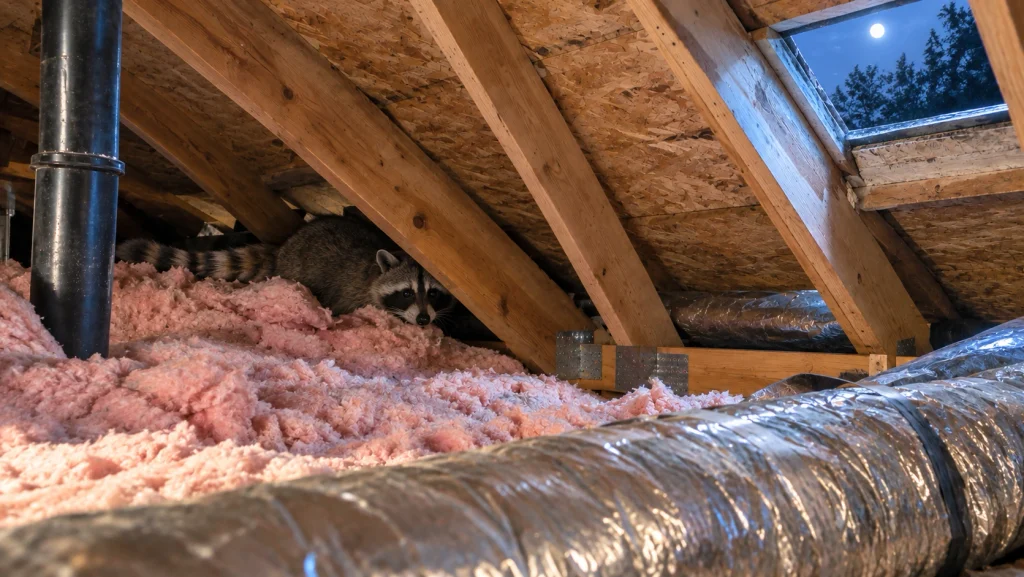
This isn’t a rare outcome. The Toronto Wildlife Centre reports receiving hundreds of calls every year specifically about baby raccoons orphaned after someone trapped and relocated their mother. It’s common enough that it’s one of the main reasons the centre and licensed operators recommend confirming the den is empty before any exclusion work begins.
Raccoon breeding season in Ontario generally runs from spring through late summer, which is also when kits are most likely to be present. This is a large part of why professional removal during this window looks different (locating and reuniting the litter, then excluding the family together) rather than a straightforward trap-and-remove.
Bats add another layer of legal complexity. The little brown bat, one of the species most commonly found roosting in Ontario attics, is listed as endangered, and exclusion work is prohibited during the maternity season roughly from May through August while flightless pups are present. If what you’re hearing turns out to be bats rather than raccoons, the timing rules that apply are stricter still.
Mini summary: Ontario law caps relocation at 1 kilometre, which is exactly why trapping an adult raccoon during breeding season risks stranding her kits. Bats face even stricter, separate seasonal protection.
What to Do Tonight
You don’t need to wait for a professional to do a few basic things safely from inside the house. If you’re dealing with noise in attic Toronto homeowners commonly notice at night, you can narrow down the likely animal significantly just by paying attention over one evening.
- Note the time of night the sound starts and stops, since this alone narrows down the animal significantly
- Listen for a single, consistent sound source versus multiple pitches, which can indicate kits are present
- Avoid banging on the ceiling or using bright lights to try to scare the animal out, since a startled raccoon with kits nearby is more likely to become defensive, not less
- Do not attempt to seal any entry point you can see from outside until you’re confident the attic is empty, since sealing an active animal inside creates a far worse problem
If the sounds point toward a raccoon, especially with kit-like chirping present, the removal process needs to account for the whole family, not just the adult. That’s the detail a proper inspection confirms before anything is trapped, sealed, or disturbed.
Key Takeaways
- Noise in attic Toronto cases usually comes down to a raccoon, a squirrel, or occasionally a bat or bird, and sound pattern plus timing is the fastest way to tell them apart
- Heavy, rhythmic thumping with a clear walking pattern points to a raccoon; light, fast scurrying points more toward a squirrel
- Nighttime activity suggests a raccoon; daytime activity suggests a squirrel
- High-pitched chittering or crying sounds may mean kits are present, which changes both timing and method for safe removal
- Ontario law limits relocated wildlife to within 1 kilometre of capture, which is why DIY trapping during raccoon breeding season risks separating a mother from her kits
- Bats are protected separately and cannot be excluded during their May to August maternity season, so correctly identifying the sound matters legally, not just practically
FAQs
What does a raccoon in the attic sound like compared to a squirrel?
Raccoons produce heavy, rhythmic thumping and walking sounds due to their size, while squirrels sound lighter and faster, closer to quick scurrying. Raccoons are most active at night; squirrels are active during the day.
Can I trap and relocate a raccoon myself in Ontario?
You can legally trap nuisance wildlife on your own property, but under Ontario Regulation 665/98 it can only be relocated within 1 kilometre of where it was caught. If kits are present in the attic, trapping the adult without addressing the litter can leave them trapped inside.
Why do I hear high-pitched crying sounds along with the thumping?
This usually means raccoon kits are present. Mother raccoons live in attics specifically to raise their young, and the kits communicate with chittering, chirping, and crying sounds.
Is it a raccoon or a bat if I smell an odour but barely hear anything?
A sharp, ammonia-like smell combined with light scratching near the roofline is more consistent with bats than raccoons. Bats are quieter overall and are often noticed by smell before sound.
When is raccoon breeding season in Ontario, and why does it matter?
The raccoon breeding season generally runs from spring through late summer. During this window, kits are more likely to be present in an attic den, which affects both the timing and method of safe removal.
Should I try to scare the raccoon out myself with noise or light?
This isn’t recommended. A raccoon that feels cornered, especially one with kits nearby, is more likely to become defensive rather than leave, and it doesn’t address whatever entry point let it in.
Can I just seal the entry point I found from outside?
Not until you’re confident the attic is empty. Sealing an active animal inside, or trapping kits away from their mother, creates a more serious problem than the original noise.
Why does it matter whether it’s a raccoon versus a bat?
The legal timing is different. Bats, including the endangered little brown bat, cannot be excluded during their maternity season from roughly May through August, while raccoon removal timing depends more on whether kits are currently present in the den.
Not sure what’s in your attic? Send us a description of the sound and timing, or book a free inspection and we’ll identify the animal and the safest legal path forward before anything is trapped or sealed.

One Response