Licensed home exterminators for bats in the attic, soffits, and roofline. Free bat inspection. Same-day appointments across the Greater Toronto Area.
Serving homeowners, renters, and property managers across Toronto, Mississauga, Brampton, Vaughan, Markham, Scarborough, North York, and Etobicoke.

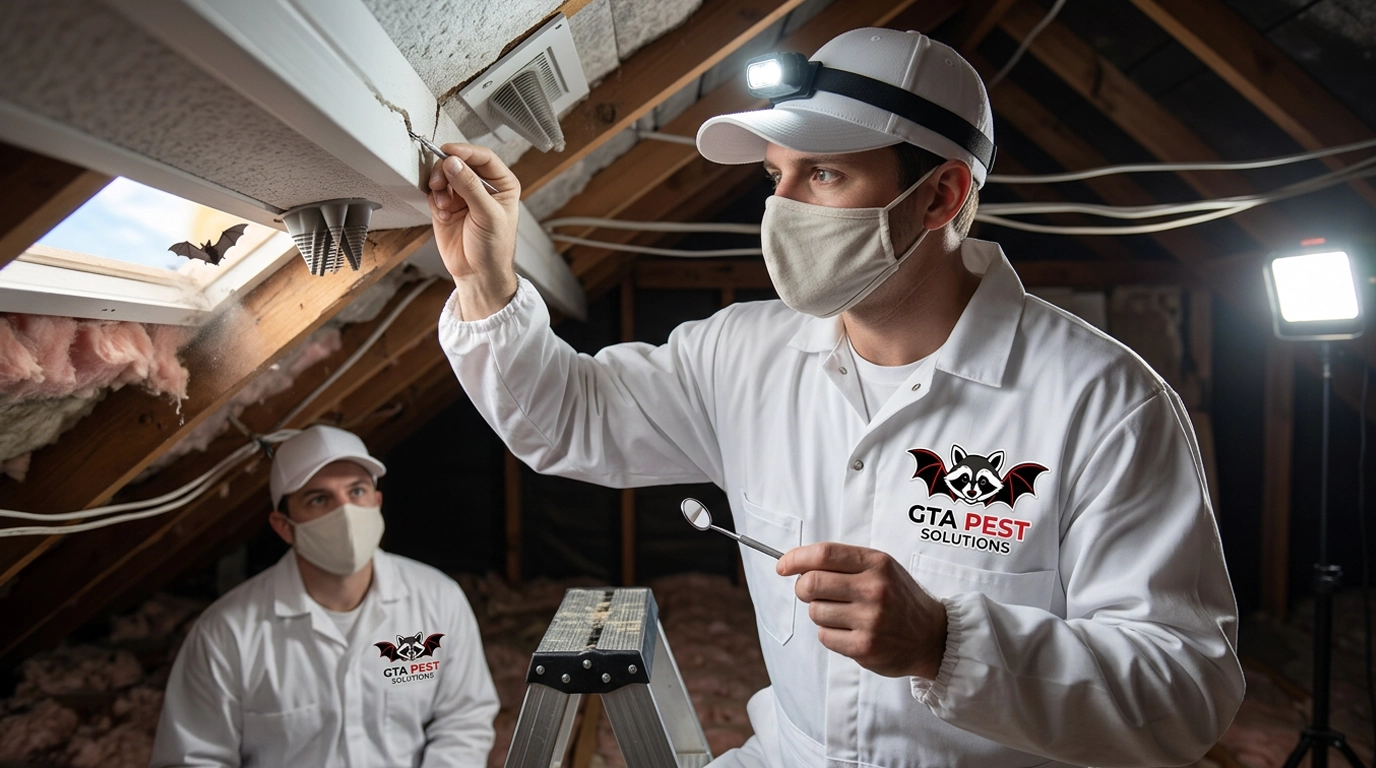
Bat Removal Toronto starts with exclusion, not a cage trap or a can of spray foam over an active roost. GTA Pest Solutions is a licensed & insured exterminator in Toronto that offers effective bat removal homeowners can trust. We find exactly how bats are getting into your attic, soffits, or roofline, let the colony leave on its own the humane way, then seal those entry points so the same gap doesn’t fill up again next summer.
Spray-and-seal jobs are actually illegal here, and dangerous. Sealing an active roost traps flightless pups inside, which kills them and leaves you with a dead-animal odour problem in the wall. That’s why every bat removal Toronto job we run is timed to the maternity season restriction, not squeezed in whenever it’s convenient.
Every visit follows Integrated Pest Management (IPM): inspect, exclude, treat, and monitor. That’s the difference between a bat problem that ends for good and one that comes back to the same soffit gap every August.
Hearing squeaking at dusk or finding droppings on a windowsill? Same-day appointments are available across the GTA.
Nearly every bat in the house call in the GTA comes down to one of two species, and knowing which one matters because only one carries protected status.
| Comparison | Big Brown Bat | Little Brown Bat (Myotis lucifugus) |
|---|---|---|
| 🦇 Build | Approximately 11–13 cm long; a bulkier species and the one most frequently encountered in GTA buildings. | ✔Approximately 6–9 cm long with a 22–27 cm wingspan; noticeably smaller and lighter. |
| ⚖ Legal Status | No special protection; the species most commonly removed from buildings. | ✔Listed as Endangered under Ontario’s Endangered Species Act following severe declines caused by White-nose Syndrome. |
| 🏠 Typical Roost | Chimneys, shutters, and small attic openings, usually in relatively small numbers. | ✔Larger maternity colonies in attics and roof voids, sometimes with dozens of bats. |
| 🌙 Habit | Typically emerges about 20 minutes after sunset to feed on flying insects. | ✔Highly loyal to its roost, often returning to the same entry point year after year unless it is professionally sealed. |
Can’t tell which species you’re hearing or seeing? Send a photo or a short clip, and we’ll confirm it for free.

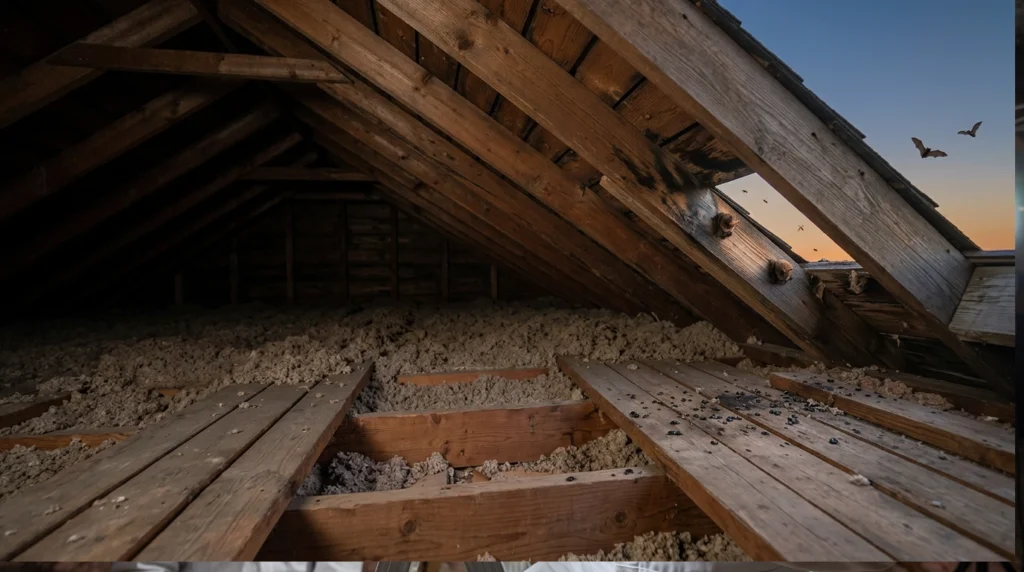
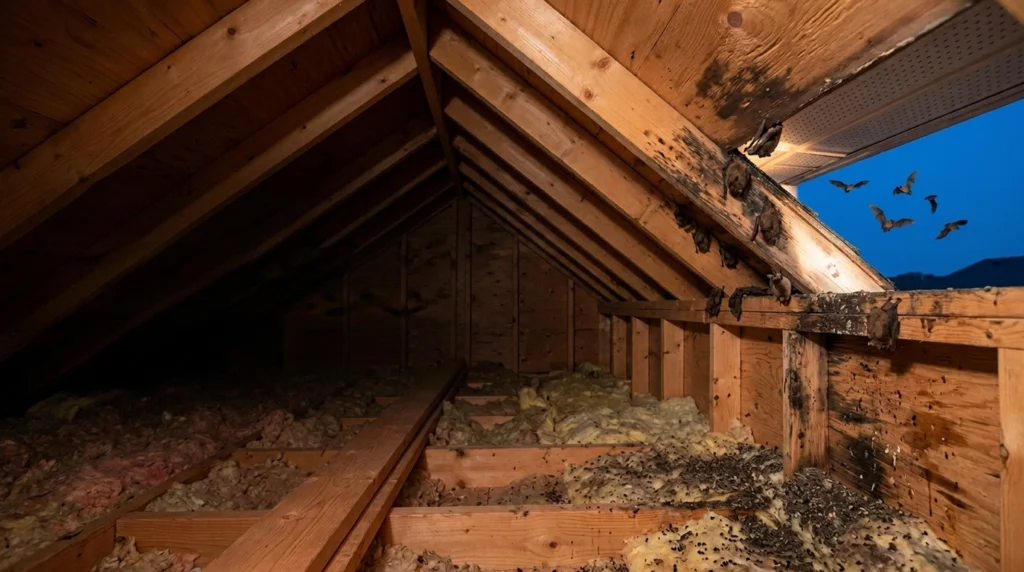
Bats are quiet by day and active at dusk, so most homeowners smell or hear a problem before they ever see a bat. Watch for:
Hearing activity at dusk? Don’t try to seal the gap yourself; book an inspection instead.

A bat colony is rarely just a noise at dusk. Bats are Ontario’s leading source of rabies exposure, and a bite or scratch can be small enough to go unfelt and unnoticed, especially if a bat is found in a bedroom overnight.
According to Canada’s public health guidance on rabies, even a very small bat bite or scratch can transmit the virus, and anyone with suspected contact should confine the room if it’s safe to do so and seek medical assessment. Accumulated droppings can also carry the fungus behind histoplasmosis, a rare lung infection linked to disturbed guano dust in enclosed spaces. This is educational information; if you’ve had contact with a bat or symptoms after cleaning a contaminated space, see a doctor or public health unit rather than self-diagnosing.
Beyond health, a long-established colony stains insulation, corrodes wood framing with accumulated waste, and can leave a lingering odour that outlasts the bats themselves if the bat guano cleanup step is skipped.
Found a bat inside a living space, or worried about a bite?
Effective bat control Toronto homeowners can rely on is a system built around a narrow legal calendar, not a single visit. Every job follows the same Integrated Pest Management (IPM) sequence used by licensed operators across Ontario:

We check the roofline, soffits, fascia, chimney, and attic interior for active entry points, droppings, and colony size.

We schedule exclusion inside the legal window, generally mid-August through October in Ontario, after the summer’s pups can fly and before winter hibernation begins.

We install one-way bat valves at every active entry point. Bats can leave to feed but cannot re-enter, and no poisons or lethal traps are used.

Once the roost is confirmed empty, we permanently repair and seal soffits, fascia, chimney caps, and roof vents with durable, chew-resistant materials.

Contaminated insulation and droppings are removed and the space sanitized; full attic restoration is available where damage is extensive.

We follow up to confirm the exclusion holds, and every completed job is backed by a written guarantee.
This is why our results last where a trap-and-spray visit doesn’t. We work around the bats’ biology and Ontario’s legal calendar, not against them.
Ready to get this handled on the correct legal timeline?
Bat activity across the Greater Toronto Area follows the region’s housing stock and green corridors:

across Toronto, Scarborough, and Etobicoke often have wood soffits, loose fascia boards, and old chimney caps that are easier for a bat to squeeze through than newer aluminium-clad builds.

near the Don Valley and similar green corridors sit closest to insect-rich foraging grounds, which draws bat colonies toward nearby rooflines.

one unit’s bat entry point behind a parapet or vent can become a building-wide problem if it isn’t sealed at the right time of year.

one unit’s bat entry point behind a parapet or vent can become a building-wide problem if it isn’t sealed at the right time of year.

large, undisturbed attic or belfry spaces are common little brown bat maternity colony sites across the GTA.

Store-bought repellents and sealants aren’t useless, but they solve a much narrower problem than most homeowners expect, and getting the timing wrong is both illegal and dangerous to the colony:

A single bat in a bedroom and an active maternity colony across a warehouse roofline need very different responses.
Our residential pest control bat service focuses on humane exclusion and permanent entry-point sealing around the home.
Homeowners: get a free inspection for your property.
Our commercial bat control programs are built for property managers, condos, and warehouses. See Commercial Pest Control for the full compliance picture, including scheduled roof and attic inspections timed to the legal exclusion window.
Businesses: need a documented, building-wide exclusion program?
What GTA Homeowners Say
For over 10+ years, GTA Pest Solutions has helped families across the region feel comfortable in their own basements again. Full guarantee terms are on our Guarantee page, credentials are listed under Licensing & Certifications , and past feedback is on Reviews .
Want results like these?

Every job is chosen with the colony, your family, and your property in mind. We use one-way doors rather than sealing an active roost outright, and we always confirm the colony’s status before scheduling work.
In Ontario, it is illegal to kill, trap, or harm bats, and the little brown bat carries additional protection as a species listed as Endangered under Ontario’s Endangered Species Act, 2007, following steep, well-documented population declines from White-nose Syndrome. This is what we mean by humane bat removal: a solution that removes the colony from your home for good without harming a species that’s already under pressure.
We ensure every exclusion falls outside the maternity season restriction, so flightless pups are never sealed inside a wall or roofline. We prioritise permanent exclusion, closing the property, over a repeat trapping visit that never seals the gap the colony is using.
Prefer a fully humane, no-harm approach? Ask about our exclusion-first process.

A licensed technician will identify the species, check for young, and give you a firm price before any work starts.
Bats are active at dusk, and you’ll usually hear a high-pitched squeak or fluttering rather than the running and scratching typical of squirrels or raccoons. An ammonia-like odour near the roost is another strong clue. If you’re unsure, send us a photo or a short recording before booking.
Cost depends on colony size, the number of entry points, and whether guano cleanup or attic restoration is needed. We quote a firm price after a free inspection, not over the phone.
Yes. We use one-way doors that let the colony leave to feed but never re-enter, and every job is timed outside the maternity season, so pups are never trapped inside.
Exclusion generally happens from mid-August through October, once the summer’s pups can fly and before bats settle in for winter hibernation. Work outside this window risks harming young bats and is not permitted.
Yes. Bats are protected wildlife in Ontario, and the little brown bat carries additional protection as an endangered species. We use humane exclusion and timed sealing instead of lethal methods.
Not if the entry point is sealed correctly. Bats are loyal to a roost site and will keep trying to get back in through any gap that’s left open, which is why permanent sealing is part of every job.
They can be. Disturbed guano dust has been linked to a rare lung infection called histoplasmosis, so we treat cleanup as a health step, not just a cosmetic one. See a doctor if you develop symptoms after exposure.
Confine it to the room if it’s safe to do so, keep people and pets away, and contact us or your local public health unit, especially if there’s any chance of a bite or scratch. Do not try to catch it barehanded.
Yes. Our commercial programs include scheduled roofline inspections, mapped exclusion work timed to the legal window, and written reports for building-wide compliance.
Whether you’re hearing squeaking at dusk or you’ve already found droppings on a windowsill, our licensed technicians are ready to help with fast, humane, and guaranteed bat removal Toronto and the entire GTA can rely on.
Ready to get on the schedule?