Licensed technicians, documented service reports, and flexible scheduling for restaurants, warehouses, offices, retail properties, and other businesses across Toronto and the GTA.
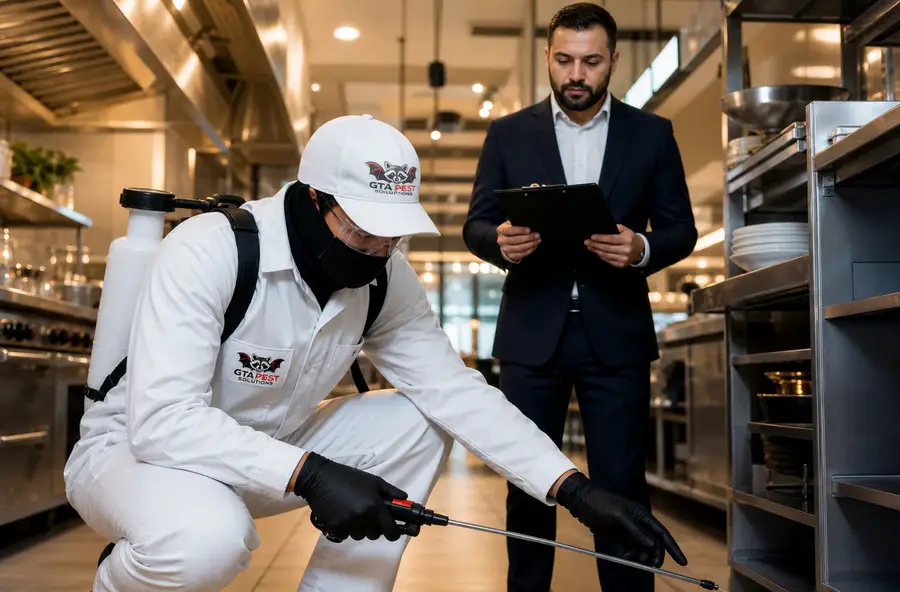
Commercial pest control protects more than your property, it helps protect inspections, contracts, customer trust, and daily operations. Pest activity can result in failed inspections, negative reviews, damaged stock, or delays in opening a business area.
GTA Pest Solutions provides licensed and insured commercial pest control services across the Greater Toronto Area. We offer scheduled pest management programs, documented service records, and emergency response options based on your property’s needs and pest concerns.
Our commercial pest control process includes regular site inspections, pest identification, targeted treatment, monitoring, and corrective recommendations. Each visit helps identify pest risks, address active problems, and reduce the possibility of recurring infestations. Clear service records also help businesses track findings, actions taken, and recommended improvements.
Food premises in Toronto must be protected against pest entry and conditions that allow pests to harbour or breed. A structured pest management program helps businesses identify pest risks, address active pest activity, and maintain appropriate service records.
| Notice | What it means | Typical pest trigger |
|---|---|---|
| Green - Pass | Requirements met; the notice customers want to see. | No evidence of pest activity. |
| Yellow - Conditional Pass | Violations found that must be corrected quickly. | Droppings, gnaw marks, or insect evidence found. |
| Red - Closed | Immediate health hazard; operations stop until resolved. | Active infestation classed as a gross unsanitary condition. |
We build each commercial pest control program around the property type, operating conditions, pest risks, and required service frequency.
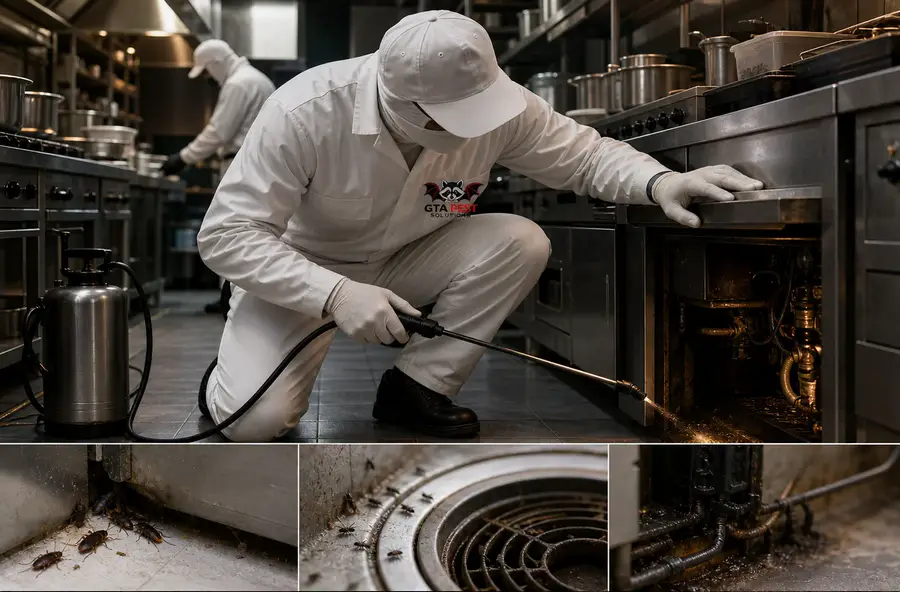
Restaurants and commercial kitchens face pest risks around food storage, preparation areas, drains, waste rooms, deliveries, and shared building spaces. Our restaurant pest control approach focuses on inspection, monitoring, targeted treatment, and practical prevention while scheduling service around business operations.
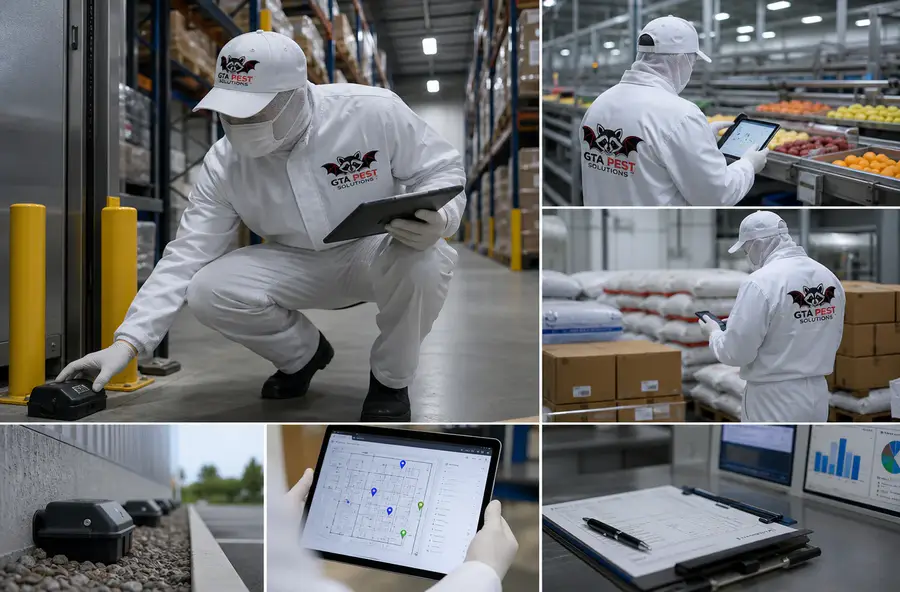
Food-processing and warehouse facilities may require monitoring records, device maps, service reports, and corrective-action recommendations. Documentation should be tailored to the facility’s internal procedures and applicable audit requirements.
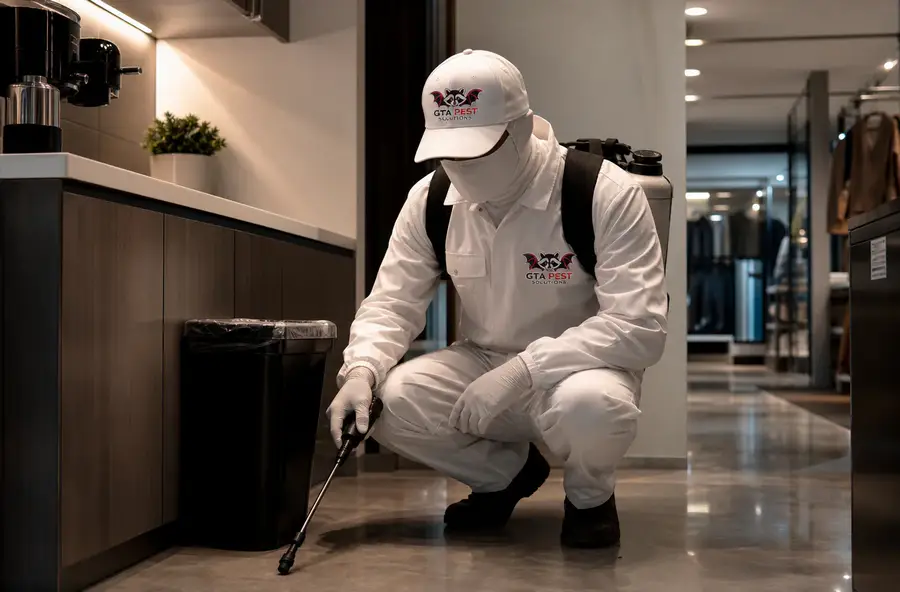
Office and retail pest control helps businesses manage pest risks in kitchens, break rooms, waste rooms, loading docks, storage areas, and shared spaces. GTA Pest Solutions can schedule services outside normal operating hours, where available, to reduce disruption to staff, customers, and daily operations. Treatment plans are tailored to the property layout, pest activity, and business requirements.
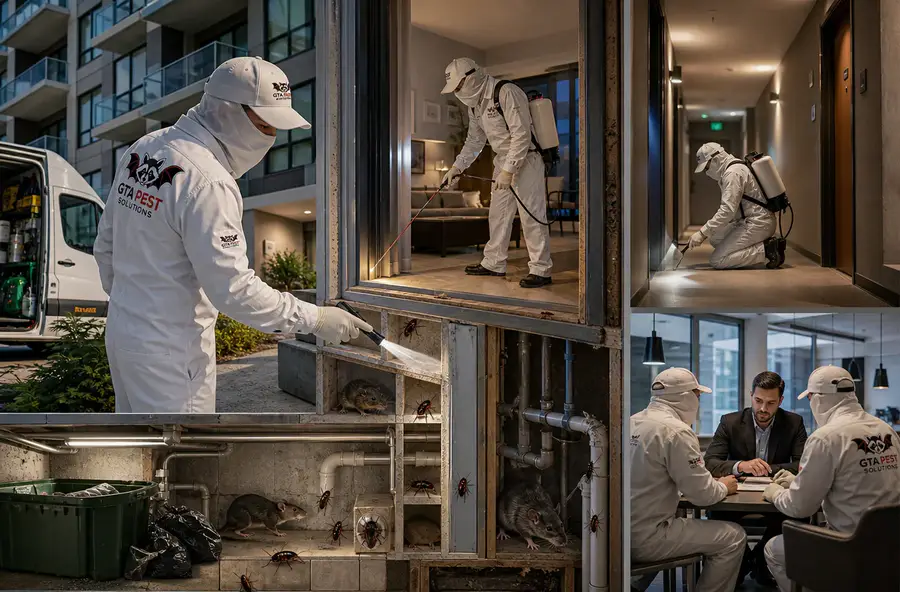
Property management and multi-unit pest control helps address pest activity across individual units, shared walls, plumbing areas, utility spaces, and common garbage rooms. Treating only one unit may not resolve the issue if pests are moving between connected areas. GTA Pest Solutions can assess affected locations, recommend targeted treatment, address access points, and provide service documentation for property managers.
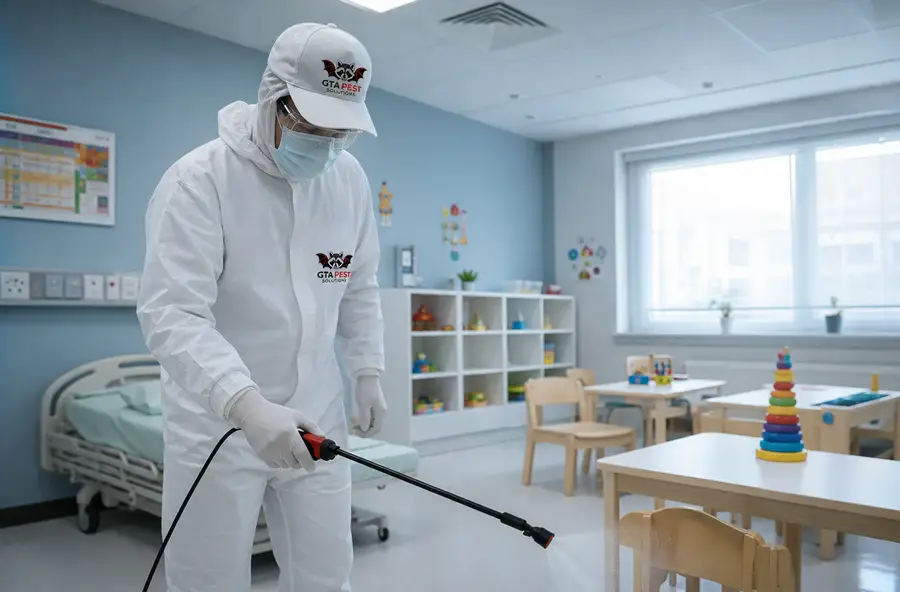
Healthcare facilities, childcare centres, and schools require carefully planned pest control because staff, children, patients, and visitors may be present during service hours. Treatment methods should be selected according to the pest issue, property requirements, occupancy conditions, and product label instructions. Where appropriate, services can be scheduled outside operating hours, with clear re-entry instructions provided in writing.
A full walk-through mapping entry points, harbourage areas, moisture sources, and food access. This becomes the baseline your program is measured against.
Materials used, application areas, device locations, service frequency, and safety data. This is the document auditors ask for first.
Weekly, bi-weekly, monthly, or quarterly depending on risk. Food service typically needs the shortest interval.
Devices are numbered and mapped, and activity is tracked over time so pressure is visible before it becomes an infestation.
Structural and sanitation issues we cannot fix with product get logged so you can show an inspector the problem was identified and addressed.
A sighting during service hours gets priority dispatch, because in food service the clock starts immediately.
Some businesses need a one-time treatment for an active pest issue, while others benefit from scheduled pest management. The right option depends on the property type, pest activity, operating conditions, and risk of recurrence.
| Comparison | One-off Callout | Managed Program |
|---|---|---|
| Trigger | You already have a visible pest problem. | Scheduled prevention before pest activity becomes established. |
| Documentation | A single service invoice. | Service logs, device maps, trend data, and an Integrated Pest Management (IPM) program document. |
| Audit Position | Nothing to show an inspector. | A documented, defensible record of ongoing pest control. |
| Cost Pattern | Lower cost per visit, but unpredictable overall. | Predictable monthly cost with fewer emergency callouts. |
| Best For | Low-risk offices and one-off wasp nests. | Food service, warehousing, multi-unit properties, and audited facilities. |
Commercial pest pressure differs from residential: the species are similar, the drivers are not.

The single most common cause of a failed food-premises inspection. German cockroaches breed fast in warm, humid kitchen voids.

Droppings and gnaw marks are what inspectors find first. Loading docks and waste areas are the usual entry route.

Drain flies, fruit flies, and house flies. Almost always a drain, waste, or organic-buildup problem rather than a spraying problem.

Beetles and moths in flour, grain, and dry goods. A costly contamination risk in warehousing and food processing.

A genuine risk for hotels, shelters, cinemas, offices with soft seating, and student housing.

Seasonal, but a patio wasp nest can shut down an outdoor service area at peak trade.

Roosting pigeons and raccoons around waste areas. Handled through exclusion; see humane wildlife removal.
Licensed and insured exterminators, with certificates of insurance supplied for your vendor file on request.
A written report every visit, formatted for DineSafe and third-party audits.
We work around your trading hours, not through them.
Priority dispatch for active infestations in food service and healthcare settings.
The same people learn your site, so problems are spotted earlier.
One point of contact and consistent reporting across your entire portfolio.
We use pet-safe, eco-friendly methods where the setting requires them, including childcare, healthcare, and occupied offices.
We provide house pest control GTA-wide across:
Pricing depends on square footage, industry risk level, service frequency, and how many sites you operate. A quarterly office program and a weekly restaurant program are very different commitments. We quote after a site survey so the number reflects your actual facility, not an average.
Yes. Every visit produces a written service report, and each account maintains a program document covering materials, device locations, and service history. These are formatted for DineSafe inspections and for AIB, SQF, BRC, and HACCP audits.
Yes. Most of our commercial work happens after close, overnight, or before opening. Restaurants, retail, and offices are usually serviced when the site is empty, so customers and staff are never present during treatment.
Confirmed commercial emergencies get priority dispatch, and we offer 24/7 emergency response for food service and healthcare sites where a sighting carries immediate regulatory risk. See our emergency pest control page for details.
Most food premises benefit from monthly service at minimum, and higher-risk kitchens often move to bi-weekly. Frequency depends on your layout, waste handling, neighbouring premises, and history. Your site survey will recommend an interval and explain the reasoning.
Yes. Multi-site clients get a single point of contact, consistent reporting across every property, and consolidated invoicing. For portfolios, we can standardise the program so every building is serviced and documented the same way.
Call us, and we attend; return visits between scheduled services are included in program accounts. Program clients get priority over one-off callouts, which is one of the main practical reasons businesses move to a managed agreement.
2985 Drew Rd # 213, Mississauga, ON L4T 0A7

Copyright © 2026 GTA Pest Solutions. All rights reserved.