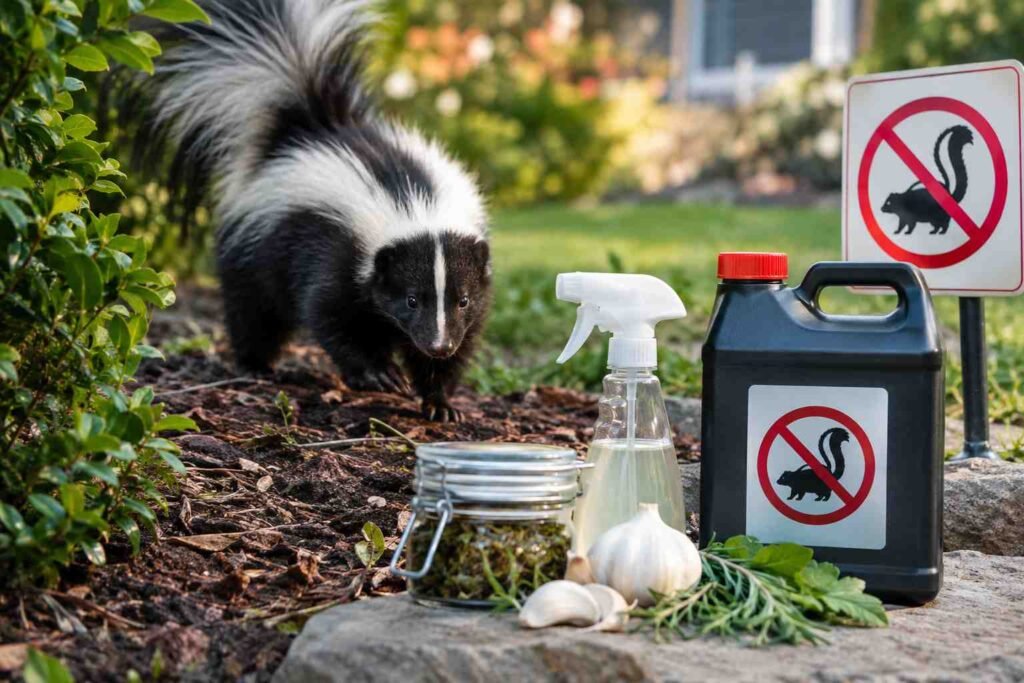
Natural and commercial skunk repellents can deter skunks in the short term, but neither is a guaranteed solution once a skunk has established a den. Canadian homeowners should also take care in the matter of pesticides and labeling. For instance, never use mothballs outside. This guide provides information on various types of skunk repellents and how each may help under certain circumstances, including methods of keeping them away from your GTA property.
Why Most Skunk Repellents Disappoint GTA Homeowners
Though repellents might sometimes drive away an animal from a given territory, it should be noted that their success largely depends on the context of the situation.
A repellent might work successfully if a skunk happens to be just moving through the yard or frequently visiting the garden. However, once the skunk has made its den underneath the deck or any other structure, driving the animal away by smell will not really address the issue at hand.
Toronto properties can provide skunks with several things they need: food, shelter, and easy access to protected spaces. The City of Toronto notes that skunks are attracted to areas such as porches, sheds, woodpiles, debris, garbage, pet food, and open compost. Lawns and gardens can also attract them because skunks feed on grubs and larvae near the surface.
That means the most effective long-term approach is usually a combination of deterrence, removing attractants, and preventing access to suitable denning areas rather than repeatedly applying the same repellent.
How to Keep Skunks Away From Your Yard
If a skunk is visiting your property but has not established a den, start by reducing the things that attract it.
1. Secure Garbage and Green Bins
Keep garbage and organic waste containers properly closed. Avoid leaving food waste accessible overnight.
2. Remove Outdoor Pet Food
Do not leave pet food or water bowls outside overnight if skunks are visiting your property.
3. Reduce Potential Denning Areas
Check spaces beneath decks, sheds, porches, and other structures. Remove unnecessary piles of rocks, debris and other materials that create sheltered spaces.
4. Manage Lawn Conditions
Skunks often dig in lawns looking for grubs and larvae, particularly when these food sources are close to the surface.
5. Use Physical Deterrents
Motion-activated sprinklers, lighting, and other physical deterrents can help make a specific area less attractive to wildlife.
6. Use Commercial Repellents Carefully
If you use a pesticide-based product, make sure it is authorized for use in Canada and that the label specifically allows the intended use. The label is a legal document and must be followed. Health Canada’s guidance on using pesticides safely explains why following label directions matters.
7. Never Use Mothballs Outdoors
Mothballs are not an appropriate outdoor wildlife repellent. Health Canada specifically advises consumers never to use mothballs outdoors.
8. Check for an Active Den Before Sealing Anything
If you suspect a skunk is living under a deck, shed, or porch, do not immediately close the opening. The animal needs to be confirmed out before permanent exclusion work is completed.
Natural Skunk Repellent Options: What Actually Helps?
“Natural” does not automatically mean effective or safe. Some commonly recommended methods may provide short-term deterrence, while others have little reliable evidence behind them.
Predator Urine Products
Fox and coyote urine products are marketed as natural skunk deterrents because predator scent may make an area less appealing.
However, their effectiveness can vary. A skunk that has already found reliable food or shelter may be less likely to abandon the area simply because of a scent.
If you choose a commercial predator-scent product, check that it is authorized for use in Canada and follow its label instructions.
Best suited for: Short-term deterrence around specific outdoor areas. Limitation: Results can vary, and repeated exposure may reduce the deterrent effect.
Strong-Scent Plant Oils and Home Remedies
Peppermint oil, citrus peels, garlic sprays, and similar remedies are frequently recommended online.
These may make a small area temporarily less appealing, but they should not be treated as a reliable solution for an established den.
Best suited for: Minor, short-term deterrence. Limitation: They usually require repeated application and are unlikely to solve an established denning problem.
Toronto’s Recommended Deterrents
The City of Toronto recommends several practical deterrents and prevention measures for wildlife problems. These include soap flakes on lawns, bone meal in garden soil, diluted hot sauce on certain fruits and vegetables, and increased lighting in problem areas.
These methods are best understood as deterrent and prevention measures, not guaranteed skunk-removal methods.
Reducing the food sources that attract skunks can be particularly useful. Toronto notes that skunks are attracted to lawns and gardens because they feed on grubs and larvae near the surface.
Commercial Skunk Repellent Products
Commercial skunk repellents generally fall into several categories. Their usefulness depends on where the skunk is active and whether it has already established a den.
Granular Repellents
Granular products are designed to be distributed around lawns, gardens and other outdoor areas.
They may be more practical than liquid sprays in locations exposed to weather, but effectiveness and application frequency depend on the specific product.
If you use a pesticide product in Canada, check the label for:
- The pest control product registration number
- The target pest
- The approved treatment location
- Application instructions
- Safety precautions
- Reapplication instructions
Do not assume that a product sold online in the United States is automatically authorized for the same use in Canada.
Spray Repellents
Liquid repellents can be useful when a homeowner wants to treat a specific outdoor area.
Their effectiveness can be reduced by rain, weather exposure, and the behaviour of the animal. A spray also does not remove a den or close the opening that allowed the skunk to enter.
Motion-Activated Sprinklers and Lights
Motion-activated sprinklers and lighting provide a non-chemical way to discourage wildlife from using a specific area.
They can be useful around:
- Gardens
- Driveways
- Patios
- Lawn areas
- Frequently used pathways
Their effectiveness depends on sensor coverage and placement. They are more useful as a deterrent than as a solution for an established den.
What Skunk Repellents Are Illegal or Unsafe to Use in Canada?
Canadian homeowners should be especially careful when following wildlife-control advice found on social media, blogs, or U.S.-based websites.
A product being commonly recommended online does not mean it is authorized for the same use in Canada.
Mothballs
Do not use mothballs outdoors to repel skunks.
Health Canada specifically states that mothballs should never be used outdoors. Mothballs are pesticides and must be used according to their authorized directions.
Using them as an outdoor wildlife repellent can expose children, pets, and wildlife to an inappropriate pesticide application.
Bottom line: Mothballs are not a legal or appropriate outdoor skunk-repellent solution.
Ammonia and Household Chemicals
Ammonia-soaked rags are sometimes suggested online as a skunk deterrent.
However, this is not a reliable long-term solution. The odour can dissipate relatively quickly, and concentrated fumes can create exposure concerns in enclosed spaces such as sheds, crawlspaces, or other poorly ventilated areas.
For these reasons, ammonia should not be treated as a primary skunk-control method.
Homemade Pesticides
Health Canada advises consumers not to make homemade pesticides, as they are untested and have no label directions to help you use them safely.
If you decide to use a pesticide product, choose one authorized for use in Canada and follow the label exactly.
Natural vs Commercial Skunk Repellent: Comparison
| Method | Canadian-use considerations | Typical limitation | Best suited for |
|---|---|---|---|
| Predator urine products | Check the product’s Canadian authorization and label | Results can vary | Short-term outdoor deterrence |
| Plant-based scents | Use according to the product directions where applicable | Often short-lived | Small areas |
| Commercial granular repellent | Use only as directed on a Canadian-authorized label | Weather can reduce effectiveness | Lawns and gardens |
| Commercial spray repellent | Follow label directions | Can wash away or require reapplication | Specific outdoor areas |
| Motion-activated sprinkler | Non-chemical deterrent | Requires good sensor coverage | Gardens, paths and driveways |
| Mothballs outdoors | Do not use | Not permitted for outdoor use and creates exposure risks | None |
| Ammonia-soaked rags | Not recommended | Short-lived and may create exposure concerns | None as a primary method |
Why Repellents Don’t Solve an Active Skunk Den
A repellent changes how attractive an area may be. It does not remove the animal, repair the entry point or address the reason the skunk selected the location.
If you notice:
- Repeated digging in the same area
- A strong skunk odour concentrated near one location
- Movement or scratching under a deck or shed
- A visible entrance beneath a structure
- Repeated skunk activity around the same property
you may be dealing with an established den rather than a skunk that is simply passing through. Not sure what animal is responsible? Learn how to identify skunk tracks in Toronto and the GTA.
At that point, repeatedly applying repellent may waste time and money.
The solution is to identify the active entry point, determine whether young are present, allow the animal to leave safely and then permanently secure the opening.
Should You Seal a Skunk Den Yourself?
Not until you know the den is empty.
Sealing an active entrance too early can trap a skunk or young animals inside a structure. This can create additional animal-welfare, odour, and property problems.
The City of Toronto advises homeowners to confirm that skunks have left before permanently closing an entrance and warns that one-way exclusion should not be used while young are dependent unless the babies are mobile.
If you suspect a den under a deck, shed, porch, or other structure, inspection should come before permanent exclusion.
When to Stop Using Repellent and Call a Professional
Repellent may no longer be the right approach when:
- A skunk has established a visible den.
- The animal repeatedly returns to the same location.
- You hear movement under a deck, shed, or porch.
- You suspect baby skunks are present.
- Repellents have produced no meaningful change.
- The skunk is repeatedly spraying near your home.
- An entry point needs to be permanently sealed.
- You are unsure what animal is using the opening.
A professional wildlife technician can inspect the area, identify the entry point, assess whether young are present and recommend an appropriate exclusion strategy.
For a full breakdown of professional removal and exclusion, see our Skunk Removal Toronto service page.
How to Prevent Skunks From Coming Back
Removing a skunk without addressing the reason it visited your property can leave the same opportunity open for another animal.
Long-term prevention should focus on both food sources and access points.
Secure Food Sources – Keep garbage, compost, and Green Bins properly closed.
Remove Pet Food – Bring outdoor pet food inside, particularly overnight.
Reduce Shelter – Clear unnecessary debris, rocks and other materials that create potential denning spaces.
Protect Areas Under Decks and Sheds – Once you have confirmed the space is empty, install appropriate screening or a prevention barrier to stop animals from digging underneath.
Address Lawn Grub Problems – If skunks repeatedly dig through your lawn, investigate whether grubs or other larvae are attracting them.
Inspect Entry Points – Check areas around decks, sheds, porches, and other structures for gaps that could provide access.
The goal is not simply to make the property smell unpleasant. It is to make the property less attractive and harder to access.
Skunk Removal in Toronto and the GTA
If a skunk has already established a den on your property, repellent may not be enough.
GTA Pest Solutions provides professional wildlife removal and exclusion services for homeowners dealing with skunks around homes, decks, sheds, porches, and other structures.
Our approach focuses on identifying the animal, determining how it is accessing the property, addressing the active situation, and securing the entry point to reduce the risk of re-entry.
Learn more about our Skunk Removal Toronto service or contact GTA Pest Solutions to arrange an inspection.
Conclusion
Natural and commercial skunk repellents can sometimes help discourage skunks from using a specific outdoor area, but they are not a guaranteed solution for an established den.
The most practical approach is to first remove food and shelter attractants, use appropriate deterrents where they make sense, and avoid products that are not authorized for outdoor wildlife use.
In Canada, never use mothballs outdoors, and always follow the label when using a registered pesticide product.
If a skunk has already established a den under your deck, shed, or porch, the priority should shift from repeated repellent applications to safe inspection, humane exclusion, and permanent prevention.
Frequently Asked Questions
Does skunk repellent actually work?
Some deterrents can temporarily discourage skunks from using a particular outdoor area, but results vary. Repellents are much less likely to solve an established den because they do not remove the animal or close its entry point.
What is the best natural skunk repellent?
There is no single natural repellent that works reliably in every situation. Predator-scent products may provide short-term deterrence, while Toronto recommends practical measures such as lighting and reducing food sources. Their effectiveness depends on the animal and the conditions around the property.
What commercial skunk repellents work?
Commercial repellents may help discourage skunks from lawns, gardens, and other outdoor areas. Granules, sprays, and motion-activated devices all have different limitations. If using a pesticide product, make sure it is authorized for use in Canada and follow the label directions.
Are mothballs illegal to use as a skunk repellent in Canada?
Mothballs should never be used outdoors to repel skunks. Health Canada specifically instructs consumers never to use mothballs outdoors. They must be used only according to their authorized directions.
Is ammonia safe for repelling skunks?
Ammonia-soaked rags are not recommended as a primary skunk-control method. They are not a reliable long-term deterrent and can create exposure concerns, particularly in enclosed or poorly ventilated spaces.
How do I keep skunks away from my yard?
Secure garbage and compost, remove outdoor pet food, reduce sheltered spaces, address lawn conditions that attract grubs and use appropriate deterrents where necessary. If a skunk has established a den, prevention should include safely addressing the den and securing the entry point.
How do I know if a skunk has made a den?
Repeated digging or odour around the same location, movement under a deck or shed, and a visible entrance can indicate an active den. If you suspect a den, do not immediately seal the opening because young animals may be present.
When should I call a professional instead of using repellent?
Consider professional help when a skunk repeatedly returns to the same location, has established a den, may have young, or has gained access beneath a structure. Professional inspection is particularly important before permanently sealing an active wildlife entry point.
Can I relocate a skunk myself if I trap it?
Ontario has specific rules governing the capture and release of wildlife. Under the applicable property-damage exception, captured live wildlife must be released within 1 kilometre of where it was captured and within 24 hours, with additional requirements such as landowner permission and compliance with municipal rules. Because wildlife capture also creates handling and spray risks, understand the applicable rules before attempting it yourself.
Key Takeaways
- Skunk repellents can provide short-term deterrence but are not guaranteed to solve an established den.
- Removing food and shelter attractants is an important part of long-term skunk prevention.
- Motion-activated sprinklers and lighting can help discourage activity in specific outdoor areas.
- Predator-scent products may provide temporary deterrence, but results can vary.
- Mothballs should never be used outdoors as a skunk repellent.
- Do not make homemade pesticides or use commercial pesticides outside their authorized label directions.
- Do not permanently seal an active skunk den until you have confirmed the animals have left.
- If a skunk has established a den, professional inspection and exclusion may be more appropriate than repeatedly applying repellent.
- Ontario has specific rules for capturing and relocating wildlife, so homeowners should understand the requirements before trapping an animal.